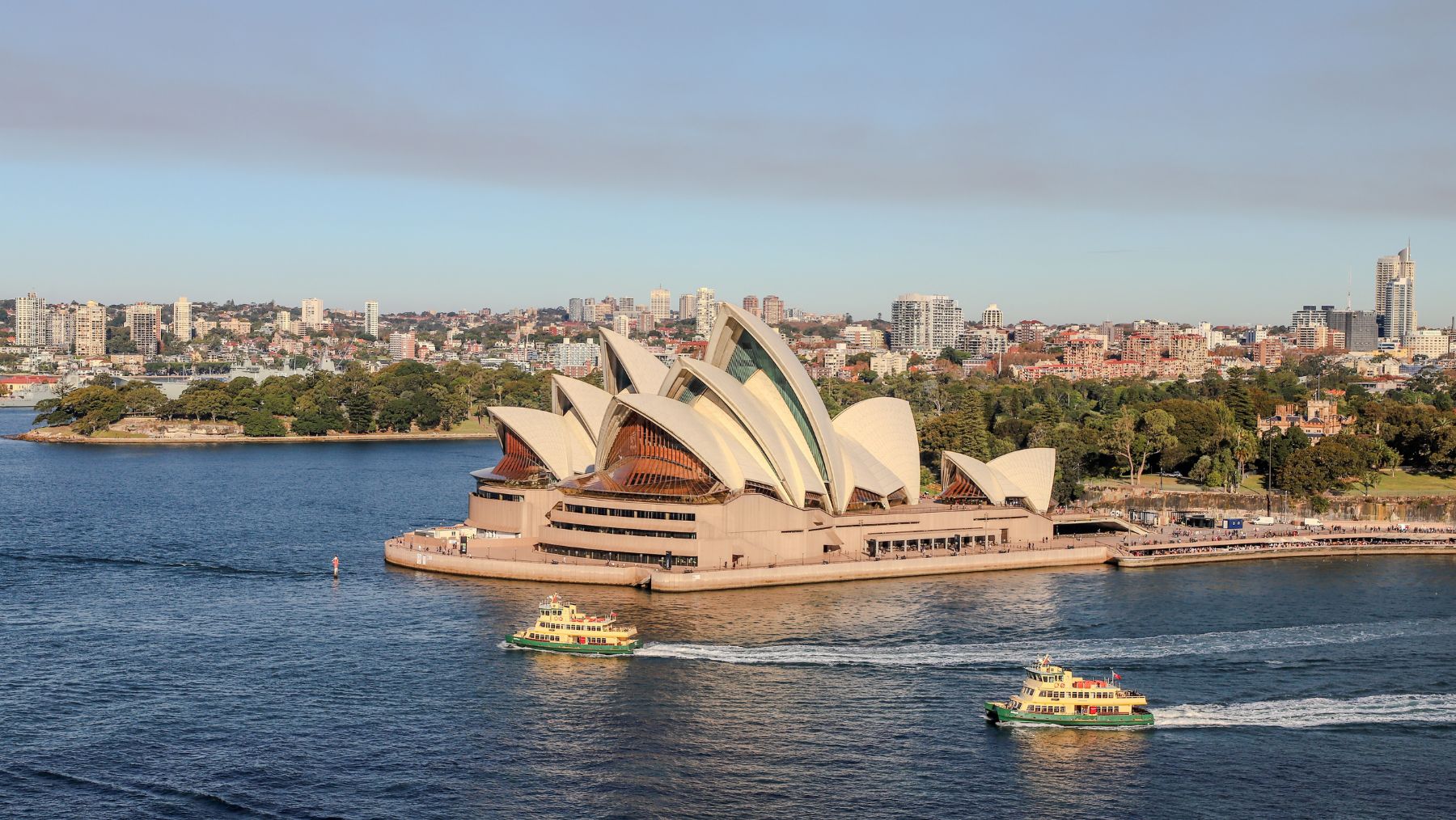
“It’s a curiosity.” That’s how Gravity & Other Myths Artistic Director Darcy Grant describes LOUDER, now playing in the Joan Sutherland Theatre at the Sydney Opera House.
And he’s absolutely right. It’s a collaboration between a classical orchestra and a contemporary circus troupe. Oh, and Johann Sebastian Bach.
The audience arrives wondering exactly how that peculiar combination is going to work. Eighty five minutes later, they’re on their feet applauding one of the most inventive and unexpectedly joyous productions to grace the Opera House stage in years.
Perhaps, though, it shouldn’t come as such a surprise.
Sarah-Grace Williams is not only one of Australia’s most accomplished conductors, she has built a reputation for reimagining classical music for new audiences. As the creative force behind Synthony—the spectacular fusion of electronic dance music, DJs, vocalists and live orchestra—she understands better than most that tradition and innovation can sit comfortably side by side.
In LOUDER, she has found equally adventurous collaborators in Adelaide circus company Gravity & Other Myths.
The result is neither a circus accompanied by music nor an orchestral concert with acrobats. It is a genuine partnership in which each elevates the other.

Picture: Sarah-Grace Williams, conductor, and the acrobats.
From the opening moments, the audience doesn’t quite know where to look. Twenty-two musicians from The Metropolitan Orchestra, elegantly dressed in concert black, perform Bach’s glorious Brandenburg Concerto.
Barefoot around them, eight acrobats begin to move almost imperceptibly, their bodies flowing across the stage like slithering snakes before suddenly exploding into astonishing feats of balance, strength and daring. Human pyramids rise in seconds. Bodies are launched skywards and caught in outstretched arms. Every leap, every fall and every impossible catch leaves the audience instinctively holding its breath.
What becomes increasingly apparent is that the orchestra and the circus troupe are practising exactly the same art.
Both depend on absolute trust. Both demand extraordinary discipline. Both rely on every individual performing their role perfectly while serving something much larger than themselves.
Grant speaks of the common bond between the two disciplines, and nowhere is that clearer than in the breathtaking confidence the four male and four female acrobats place in one another. They hurl themselves from impossible heights, knowing someone will be there to catch them. It is the physical equivalent of what happens every time Williams steps onto the podium: she raises her baton with complete confidence that every member of her orchestra will respond as one, perfectly in tune, perfectly in time.
That shared trust becomes the invisible ninth performer on stage. And it is utterly captivating.

There is comedy and audience participation, too. Williams strides off the stage, leaving acrobat David Trappes with a frock coat and baton. Of course, he conducts the orchestra. And persuades the audience to sing along.
Watching LOUDER is rather like watching two different languages suddenly become one. The orchestra never stops playing. The acrobats never stop moving. Bach’s intricate melodies become physical architecture as bodies rise and fall with the music, every movement perfectly calibrated to Sarah-Grace Williams’ baton.
The audience, understandably, doesn’t quite know where to look. One moment they are admiring the precision of The Metropolitan Orchestra, dressed immaculately in concert black. The next, they are collectively holding their breath as Gravity & Other Myths’ four men and four women launch themselves into another seemingly impossible feat.
The choreography is mesmerising. The performers slither across the stage like a single organism before suddenly transforming into towering human sculptures. A shoulder becomes a foothold. A hand becomes a platform. They appear super-human.
Every catch earns an audible gasp. Every successful landing is greeted with spontaneous applause. It is exhilarating theatre.
When an acrobat throws herself backwards from two metres into the air, she never once glances behind her. She simply knows her colleagues will be there.
Williams deserves enormous credit for keeping this complex production together. Conducting an orchestra is demanding enough. Conducting while synchronising live musicians with split-second acrobatic timing is something altogether different. The performance never once loses its rhythm or momentum. And she is clearly enjoying herself.
Musically, Bach’s glorious Brandenburg Concerto No. 2 provides the familiar backbone of the evening, while contemporary compositions by Sxip Shirey and Quincey Grant add texture, humour and drama.
Gravity & Other Myths have long established themselves as one of Australia’s finest contemporary circus companies, but LOUDER demonstrates they are artists as much as athletes. Their extraordinary strength is matched by remarkable grace, comic timing and an ability to tell stories without uttering a single word.
In a world where many productions rely on technology, projections and special effects to impress audiences, LOUDER strips performance back to its essentials: human bodies, human skill and human collaboration.
The result is thrilling and uplifting. This curious idea turns out not to be curious at all. It is one of the most original and rewarding productions currently playing in Sydney, and sadly it only lasts until Sunday.
Pictures: Peter Lynch and Daniel Boud.
FACT FILE
What: LOUDER – Gravity & Other Myths with The Metropolitan Orchestra conducted by Sarah-Grace Williams
Where: Joan Sutherland Theatre, Sydney Opera House, Bennelong Point, Sydney
When: 25–28 June 2026
Running time: Approximately 85 minutes, no interval. Recommended for ages 8+.
Tickets: From around $89 (some ticketing partners advertise from $84, depending on availability and seating).
Website: www.sydneyoperahouse.com