- Jane Austen’s Pride & Prejudice is one of the most revered romantic novels in English literature.
- Could it possibly be turned in to a musical comedy?
- This production says “Yes” – and the result is side-splittingly good.
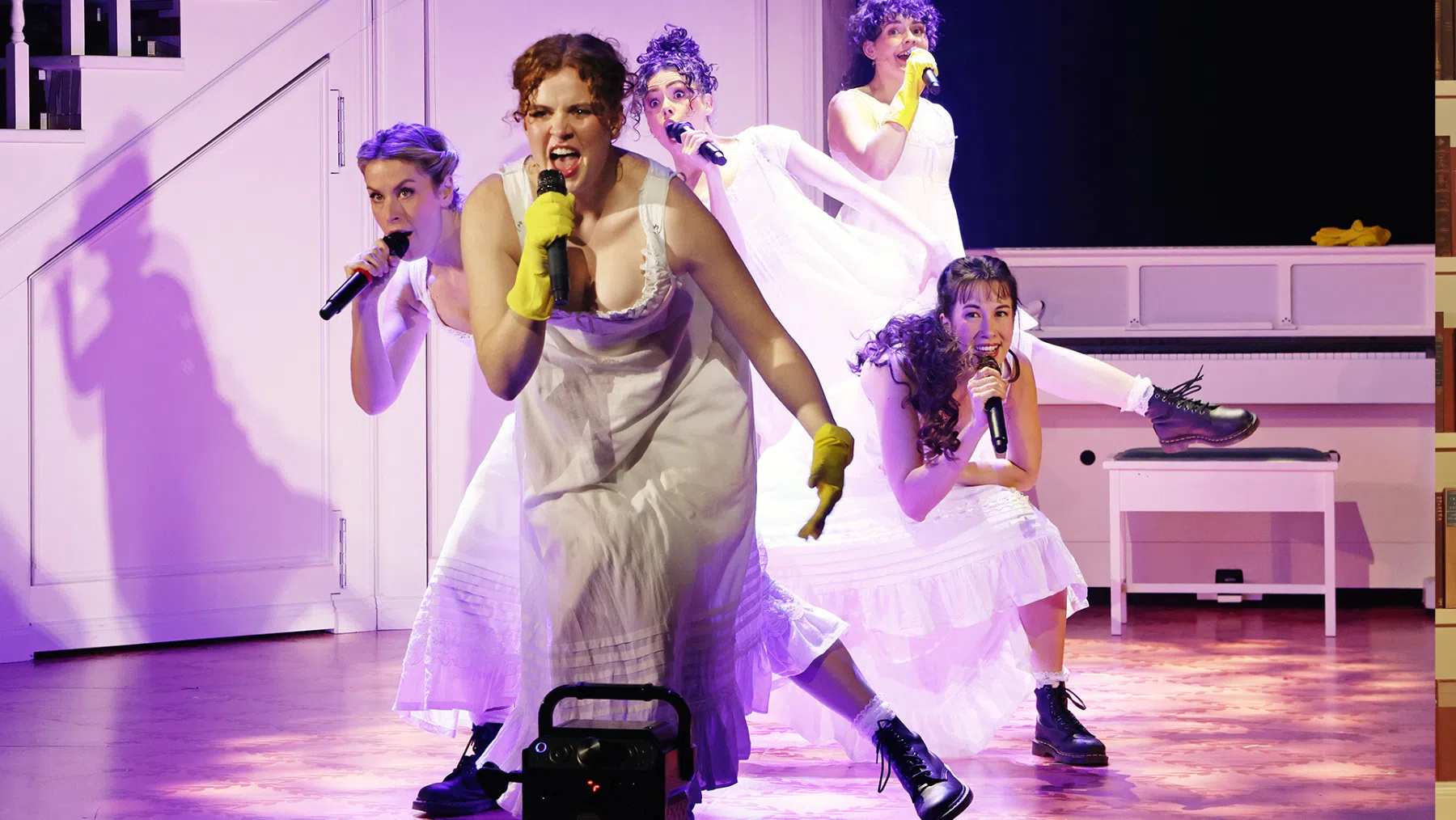
Imagine putting the world’s most revered romantic novel into a cocktail shaker with a generous dash of slapstick, disco music, karaoke and five sassy female performers playing every part. Shake vigorously, add a glitter ball, and you have Pride & Prejudice (sort of)—Isobel McArthur’s brilliantly funny musical comedy now playing at the Sydney Opera House.
Jane Austen’s novel was published in 1813 and has since been transformed into films, television series and countless stage adaptations. None of them is quite like this.
McArthur’s version is fun, frivolous and surprisingly true to Austen’s story – sort of. Elizabeth Bennet and Fitzwilliam Darcy still spar their way towards romance. Jane Bennet still falls for the amiable Charles Bingley. Mrs Bennet remains determined to marry off her daughters, while the family’s future hangs on the arrival of an eligible male heir.
The familiar upstairs story is all there, but this time it is told from downstairs, through the eyes of five servants who have been cleaning up after the Bennets and their socially superior friends for more than 200 years.
In fact, the performance begins before it officially starts. As the audience files into the Drama Theatre, the cast is already on stage and in the auditorium, dusting and cleaning. All five appear to be preparing the room for the privileged people whose lives are usually considered important enough to command our attention.

It is a clever introduction to a new concept: the servants have always been there, even if Austen and generations of adapters barely noticed them. Now they are taking over the story and every role in it.
The production proceeds at a breathless pace as the five performers switch between servants, Bennet sisters, anxious parents, eligible bachelors, pompous clergymen and formidable aristocrats. Sometimes the transformation requires a complete costume change. At other times, a hat, jacket, posture or ludicrous facial expression is enough to create an entirely new character.
The result is bewildering, always impressive and very, very funny.
The cast members sing and act their way through as many as five characters each, male and female, with extraordinary professionalism. They negotiate rapid costume changes, physical comedy, audience interaction, karaoke machines and pop songs without losing control of the story.

Teo Vergara gives us servant Effie and a wonderfully spirited Elizabeth Bennet, the intelligent and independent young woman who refuses to accept that wealth, rank or an impressive country estate automatically make a man worthy of her.
Zoe Ioannou plays servant Flo, the permanently marriage-obsessed Mrs Bennet and, in a wonderfully audacious piece of casting, Fitzwilliam Darcy. Her Darcy is starchy, aloof and magnificently self-satisfied – at least until Elizabeth begins dismantling his assumptions about himself.
And, of course, “You’re So Vain” is reserved for Mr Darcy. Who else?

Amy Lehpamer plays Tillie, Charlotte Lucas, Charles Bingley and Miss Bingley, creating distinctly different personalities at such speed that it is easy to forget they are being played by the same actor. Her cheerful, puppy-like Bingley is particularly delightful.
Kaori Maeda-Judge takes on Clara, Jane Bennet, the charming but duplicitous George Wickham and the imperious Lady Catherine de Bourgh. Her transformations are among the evening’s most dramatic, moving between romantic innocence, swaggering masculinity and aristocratic outrage.
Ruby Shannon makes a remarkable professional theatre debut, playing Anne, Mary Bennet, Lydia Bennet, Mr Collins and Mrs Gardiner. Her painfully pompous Mr Collins is an inspired comic creation, while Lydia provides the reckless energy required to send the Bennet household into crisis.
Together, the five performers play more than 20 characters and generate the energy of a cast many times their size. They are the real stars of a production performed on a single set, proving that comic precision, timing and imagination can create a far richer world than a stage production costing tens of thousands.
The pop songs are not merely inserted as musical decoration. They are emotional shorthand for feelings that cannot be expressed within the restrained manners of Regency England.
Alongside “You’re So Vain”, there is George Michael’s “Careless Whisper”, Cyndi Lauper’s “Girls Just Want to Have Fun”, Sade’s “Smooth Operator” and Steely Dan’s “Rikki Don’t Lose That Number”.
Karaoke machines appear, microphones are fought over, and a disco ball transforms the drawing room into something closer to an exuberant hen party.
The collision between Austen’s world and modern pop music shouldn’t work. Yet, somehow, it does.
Much of the comedy comes from puncturing the solemnity that has accumulated around Austen’s novel. This is not a reverential literary adaptation. It is a gleeful attack on the bonnets, manners and masculine entitlement of Regency England and the genre of “bodice ripper” books.
Yet McArthur never mocks Austen herself. Beneath all the silliness is a clear understanding of why Pride and Prejudice has survived for more than two centuries. Austen’s women are attempting to secure love, independence and financial security in a world where they have little direct control over any of them.
The show’s irreverent modern perspective makes those stakes clearer, not less important. The jokes are contemporary, but the women’s frustrations feel entirely familiar.

First performed in 2018, McArthur’s adaptation subsequently reached London’s West End and won the 2022 Olivier Award for Best Entertainment or Comedy Play.
Its Sydney season demonstrates precisely why: it is inventive, intelligent and riotously entertaining without becoming so pleased with its own cleverness that it forgets to tell the story. The official Australian production history and cast details are available here.
Women will particularly enjoy its subversive view of male vanity and the rigid social rules surrounding courtship and marriage. But you do not need to be a woman – or even an Austen devotee – to surrender to it.
The woman sitting beside me was literally wiping away tears of laughter. She was not alone. The Drama Theatre repeatedly erupted as the performers pushed a scene towards apparent absurdity, found one more joke and then somehow topped it again.
At 160 minutes, including interval, the production is substantial. But its pace, songs and constantly changing characters give it the momentum of a much shorter show.
This is Austen liberated from the drawing room: affectionate but anarchic, frivolous but deceptively smart. It retains the romance, social observation and emotional heart of the original while adding karaoke, Doc Martens, disco and glorious comic chaos.
Is it really Pride and Prejudice?
Yes—sort of.
Is it the most hilarious show on the Sydney stage today?
Absolutely.
Fact file
What: Pride & Prejudice (sort of), by Isobel McArthur after Jane Austen
Where: Drama Theatre, Sydney Opera House, Bennelong Point
When: Until August 30, 2026
Running time: 160 minutes, including a 20-minute interval
Tickets: From $49.90 for selected performances, with full-price tickets ranging from $64.90 to $129.90 depending on the performance and seating reserve. An $8.95 transaction fee applies. Prices and availability may change.
Bookings: Sydney Opera House or phone (02) 9250 7777
Please note: The production contains coarse language, flashing lights, haze, smoke and loud bangs.