A captivating new exhibition has landed in The Rocks, offering a deep dive into the human body and the powerful link between our emotions and physical well-being.
Just a short stroll from Circular Quay, you’ll find an exhibition guaranteed to be unlike anything you’ve ever seen before.
Body Worlds: The Anatomy of Happiness has officially made its Sydney debut, taking over the conveniently located gallery space at 155 George Street in The Rocks.
Although this edition of Body Worlds premiered globally in Brisbane last year, the broader exhibition series was created 31 years ago by pioneering German anatomist Dr Gunther von Hagens.
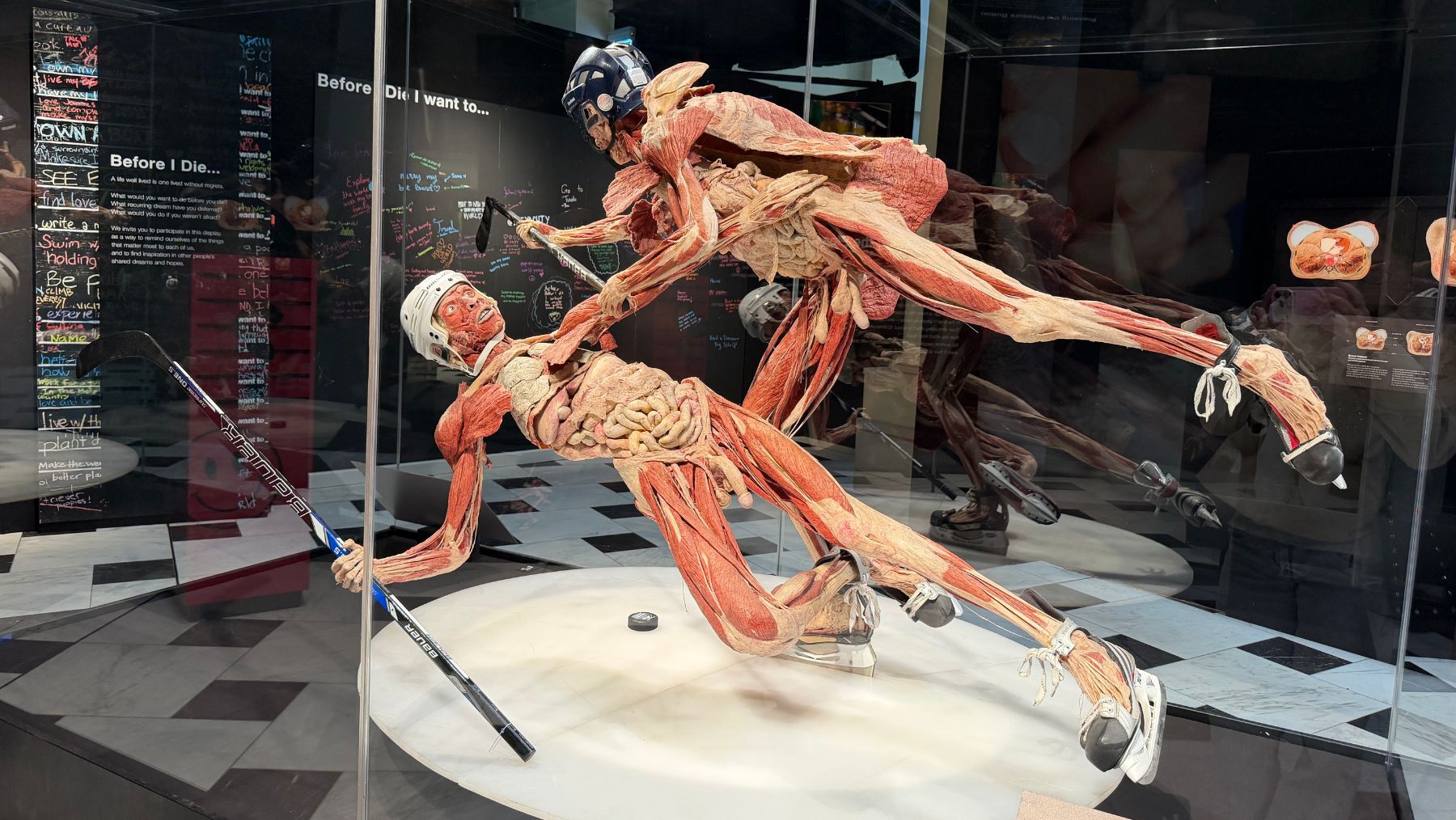
Using real human bodies preserved through von Hagens’ groundbreaking plastination technique (the same method used for the original Body Worlds exhibition), this new spin-off explores the science of happiness and its effects on the body and mind. Through these specially donated specimens, visitors can observe the human body in a uniquely intimate way.
We understand that seeing this graphic anatomy up close and personal like this may not be for everyone (if you didn’t like dissections in high school, this may not be for you), but for those fascinated with the science of our emotions and physical well-being, there’s no better way to explore the human body and its fascinating quirks.
As Dr Gunther von Hagens stated himself, “My goal is to show visitors the true-to-life wonderful complexity of human and animal anatomy. Plastinates are meant to remind each of us of our own mortality, and what a wonderful gift life is.”


Real human bodies are used in Body Worlds: The Anatomy of Happiness. (Image: Isabelle James).
Real human bodies offer extraordinary insight
The purpose of Body Worlds: The Anatomy of Happiness is to explore the powerful connection between happiness, emotions and physical wellbeing. Using intricate displays, the exhibition covers topics like stress, ageing, balance, nutrition and disease.
What sets Body Worlds apart, however, is the use of Body Donors to give visitors an incredibly authentic and deeper look at the human body.
I found one of the more interesting aspects of the exhibition to be the explanation of these donors. A sign reads,
“All anatomical specimens on display are authentic. They belonged to persons who declared during their lifetime that their bodies should be permanently preserved and made available after their deaths for the qualification of physicians and the instruction of laypersons.
The identities, ages and causes of death of the individual body donors are not given with these exhibits, because the exhibit focuses on the nature of our physical being, not on providing personal information on private tragedies.
The body donors chose to participate in this program for a variety of reasons. All wanted to contribute to the medical enlightenment of laypeople, and without their contribution, this exhibition would not be possible.”
The use of plastinated figures offers an extraordinary insight into the intricacies of the human body, revealing how every vessel, tendon, bone and organ works together in coordination to keep us moving and functioning.
Reflecting on life and death, ageing and happiness
There’s no doubt that Body Worlds is an incredibly educational exhibition, with detailed commentary accompanying each display to explain exactly what you’re looking at.
You’ll discover that while the brain accounts for just two per cent of our total body weight, it receives around 20 per cent of the body’s blood supply. You’ll also learn that if the blood vessels in an average adult were laid out end to end, they would stretch for an astonishing 9,000 to 19,000 kilometres.
You’ll also learn about happiness, stress, balance and ageing. One sign reads “Stress Can Kill” and discusses how our body’s stress response evolved to help us survive: when we detect a threat, it readies us for fight or flight.
Another sign tells us “You Are What You Eat”, informing us that we need more than 40 different nutrients to stay healthy, and that as we age, our energy needs change. Our need for food actually decreases from age 30 onward by about 8% per decade.
But it’s not all fact after fact after fact: there’s a duality to the exhibition. It’s also made for reflection.
One sign reads, “Balance is essential for our physical, mental and emotional well-being”. It’s a sentiment that runs through the exhibition, which repeatedly encourages visitors to think about how we treat our bodies, minds and time.
There’s also a display that shows us the DNA of Happiness, stating that 50% of our ability to be happy depends on our genetic marker or set point. About 40% is determined by our thoughts, actions and behaviours, and only 10% by our circumstances in life: financial, physical, marital or social.

You’re offered practical advice on ageing and how to embrace it, from “eating a rainbow” to making “exercise and motion a way of life”.
There are also poignant reminders about the sheer improbability of our existence. One display uses grains of rice to illustrate the millions of possible combinations that could have resulted in a different life, encouraging you to pause and consider just how remarkable it is that you’re standing in this space at all.
The final display you see is a big blackboard with colourful pens ready for your use. It reads in big letters, “Before I die, I want to…”
Visitors can write their own hopes and ambitions across the wall, giving you a nice little elated feeling as you leave the building.
It brings the exhibition back to Dr Gunther von Hagens’ desire to “remind us of our own mortality and what a wonderful gift life is.”
And perhaps that’s what stays with you most. Body Worlds: The Anatomy of Happiness is not just an exhibition about what lies beneath our skin. It’s a reminder of how extraordinary the human body is, how fleeting life can be and, ultimately, how important it is to make the most of it.
Body Worlds: The Anatomy of Happiness
Where: 155 George St, The Rocks, Sydney NSW 2000.
When: Running until April 4, 2027.
Price: Tickets from $37.