- Ahead of its opening, we went and checked out all five opening exhibitions at the new Powerhouse Parramatta.
- Highlights include Es Devlin’s immersive The Turning, the First Nations-led Overflow, and Task Eternal.
- Here’s our verdict on whether you should check out the $915 million museum.
A day before its official opening, we headed west to Powerhouse Parramatta to explore its five new exhibitions, tour the building and hear from those instrumental in its creation, construction and curation.
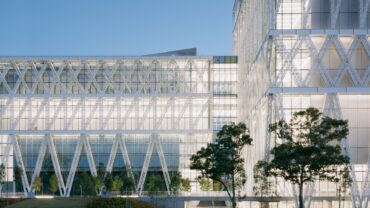
The sun is shining as we gather on the manicured lawn in front at the intersection of the two buildings. The outdoor space overlooks the gently rolling Parramatta River, and a huge commission by artist and stage designer Es Devlin, who is behind one of the five opening exhibitions, looms over us.
It’s a seriously momentous day for the team behind the $915 million Powerhouse Parramatta building. Standing in front of the towering structure (officially the largest museum in New South Wales), it’s hard not to get swept up in the excitement.
Interim CEO Abbie Galvin describes the museum as “a cultural backbone for Western Sydney”, while Minister for the Arts John Graham promises it “will change people’s lives”.
It’s a historic day for Western Sydney, but the big question is: is Powerhouse Parramatta worth a visit?
We’ve explored all five opening exhibitions to find out whether this landmark new museum is worth the trip (and the train ride) out west.
Powerhouse Parramatta review
A huge new landmark

Powerhouse Parramatta stands at 75 metres tall, spans 30,000 square metres of interior space and features 18,000 square metres of public and exhibition space. So yes, it feels very, very big – more like a precinct than a museum.
Locals have already christened the building the “milk crate” for its distinctive white steel-lattice exoskeleton, made up of 1,300 individual pieces.
Inside, huge windows flood the building with natural light, while views of the Parramatta River appear around almost every corner. Given such a desirable waterfront setting, it would be a shame not to make the most of it – and thankfully, the architects have done just that.
The museum is also home to Simara, a 290-seat fine-dining restaurant overlooking the landscaped gardens and winding Parramatta River. I picture a balmy evening, a table on the outdoor terrace and a dish from chef Simon Sandall’s kitchen. It’s a hard combination to beat.
One issue I did notice is that there’s very minimal signage, and this, paired with the museum’s huge, expansive rooms, makes it difficult to know where you’re going. Make sure to grab a map or familiarise yourself with the building beforehand if you can, just to make it easier to find the exhibition you want to go to.
Task Eternal

Task Eternal is the only exhibition that costs money to go to if you’re an adult. It will set you back $30, and you can also add on a James Turrell experience, titled Shangri La (Over The Hump), for an extra $10.
One thing about Task Eternal? It is huge, which is obviously a theme for Powerhouse Parramatta. You could actually spend about two hours here looking at everything on display. There are over 850 objects, including a massive collection of aviation and space artifacts.
The exhibition is inspired by Ted Chiang’s science fantasy novelette, The Tower of Babylon, and has four “acts” titled Skyward, Power, Off-Earth, and The Return.
Highlights include an enormous 8,400-kilogram F1 rocket engine and a collection of Leonardo da Vinci’s original drawings for flying machines.
A monumental kinetic sculpture by Torlap Larpjaroensook hangs from one ceiling, commissioned especially for Task Eternal. Hanging over a mirrored surface, the installation creates an almost infinite visual effect.
There’s plenty of Australian history woven through the exhibition, too. At both the beginning and end, visitors encounter an early 19th-century Burramattagal boomerang, a significant object created by First Nations peoples in Parramatta. Returned to Country from London, its presence feels particularly special.

Elsewhere, an entire room is dedicated to Qantas, with the airline’s historic uniforms displayed against a bright red backdrop. It’s not surprising that the airline is getting a lot of love, given Qantas is the official presenting partner of Task Eternal.
This exhibition delivers on both quantity and quality, with so many things to see and plenty of immersive aspects. There’s even a playground with a slide halfway through, for any kids who need a break from learning and want a run around.
I’d definitely recommend buying a ticket to this exhibition, although it’s not without its flaws.
At times, it feels as though the curators have gathered every space-related object they could find and squeezed it into one room.
The exhibition is divided into four “acts”, but the narrative connecting them isn’t always clear. Still, there’s no shortage of fascinating objects and installations to admire, and that’s what makes it worth visiting.
The James Turrell installation, however, left me a little underwhelmed.
Visitors step into a glowing red room designed to disorient the senses, recreating the shifting light and colour experienced by pilots in flight, where depth, distance and spatial boundaries begin to dissolve. It’s an interesting concept, but I was expecting something a little more spectacular.
Es Devlin: The Turning

It’s Es Devlin’s debut exhibition in Australia, and she hasn’t held back.
The Turning presents five commissions, titled Forest of Us, Memory Palace, Collective Portrait, Screenshare and Redraw the Edges of Yourself.
I can promise you that selfies in Forest of Us will soon flood your feed. It’s a giant two-storey mirror maze that you can stroll around, observe yourself from all different angles and see endless images of others. It has a similar feel to a teamLab exhibition, with its immersive, multi-sensory approach.
Collective Portrait features a 24-metre-long table with a paper scroll down the middle of it. Each visitor is encouraged to sit opposite a stranger and take time to draw their face. It’s awkward, but I guess that’s the whole point, and it’s quite funny to see everyone’s artistic attempts scrawled on the paper.
The final room, Redraw the Edges of Yourself, offers visitors the chance to take home a sketch by Devlin. A projection of dancing figures plays across the wall before a series of hands appear, inviting you to pluck a drawing from the display.
You can choose whichever one catches your eye (as long as you can reach it from the wall), making for a rather special souvenir to take home from the exhibition.
The Turning was my favourite exhibition in the museum, thanks to its immersive installations and the way it encourages visitors to get involved.
The intended demographic does feel a little unclear, though. While younger children would undoubtedly love running around Forest of Us, other parts of the exhibition call for a little more patience, quiet and reflection. I’d perhaps save this one for a child-free visit, or at least only bring kids aged 10 and up.
I spoke to Es Devlin herself, who had very positive things to say about the museum. She told me, “I think this place is going to become a global destination… It’s an extraordinary day out. I mean, I’ve never seen anything like it, and I’ve been around!”
Overflow

Overflow is Powerhouse Parramatta’s First Nations-led exhibition grounded in the living principles of Water Country.
It features a recreation of a flood plain, an ode to Parramatta’s flood plain, and guests are welcome to remove their socks and shoes and walk through the water. The water rises and falls by 10 mm every 30 minutes.
As visitors wade through the shallow water, Beau James, Powerhouse’s Director of First Nations, states, “That girl walking there, it looks like she’s walking on Country.”
Behind the water, a screen brings the stories of Aboriginal-led organisations from across New South Wales to life, highlighting their work caring for saltwater and freshwater ecosystems. The exhibition showcases Aboriginal knowledge as a living, active system of environmental care, offering a deeper understanding of what it means to be a custodian of Country.
These stories are captured through the cinematic lens of acclaimed filmmaker and Kamilaroi man Ivan Sen.
This exhibition is not only a moving tribute to Parramatta and Country, but it’s also a visually spectacular experience. It’s hosted in a room that has views out of both sides of the building, and natural light pours into the room. At sunset, this would be absolutely incredible.
You don’t need to set aside too much time for Overflow, as it’s contained within a single room. However, its immersive visual spectacle is likely to appeal to visitors of all ages, as well as locals and tourists.
The Mall

It does seem pretty random that there’s an exhibition about shopping malls at the museum, but they’ve actually got a strong link to Western Sydney.
The first Westfield shopping centre opened in Blacktown in 1959, pioneered by Frank Lowy and John Saunders. There are now more than 80 of the shopping centres around the world.
Unfolding across two storeys, The Mall comprises five distinct architectural spaces: Arcade, Desire, Transaction, Ideal City and Forum.
Centred in the exhibition is a contemporary reimagining of Southwest Sydney’s Roselands Raindrop Fountain, which uses lighting to look like cascading water droplets.
One of my favourite elements was the large-scale recreation of a 19th-century Sydney arcade, complete with shopfronts from iconic Australian brands including Breville, Oroton, R.M. Williams and Sportsgirl. There’s even a festive Christmas display from David Jones, a nostalgic touch for visiting Sydneysiders.
I’d argue this exhibition will resonate more strongly with Sydneysiders than international visitors.
There’s a wonderful sense of nostalgia throughout, celebrating the history of homegrown brands and cultural touchstones that hold a special place in Aussie hearts, but may not carry quite the same significance for overseas visitors.
The Dark

The Dark was one exhibition I struggled to get behind.
Aimed at children aged four to 12, it’s fun to explore, and there are certainly clever parts, but I’m not entirely convinced it delivers on its central promise.
One of the best things about it is that visitors aren’t allowed to take their phones inside, offering a welcome break from screens and encouraging you to properly engage with what’s around you.
Visually, it’s a lot of fun, and I’m sure younger visitors will get a kick out of it. However, it’s advertised as an exhibition designed to help children overcome their fear of the dark, and I struggled to see how the experience actually achieves this.
There’s an impressive mineral collection and a quirky recreation of a bedroom, complete with a Labubu. You can even jump out of the bedroom window to enter the next space.
It’s entertaining enough, but I don’t see how it will cure any child’s fear of the dark. I’m sure youngsters will have fun exploring it, but don’t expect them to stop knocking on your door at night when they’ve had a nightmare.
Our verdict

Should you go and visit the new Powerhouse Parramatta museum? Absolutely.
The scale is staggering, the building feels genuinely fresh and original, and it has all the ingredients to become the cultural powerhouse so many have promised it will be.
It’s been a long time since I’ve seen such an extraordinary collection of artefacts, objects and artworks under one roof.
Yes, sometimes it does feel a bit random, and there is so much space to fill, which means there’s so much stuff to see, but when it comes to bang for your buck, I struggle to think of many places offering quite so much for so little.
Don’t make the same mistake I did and try to cram all five exhibitions into five hours. Powerhouse Parramatta is enormous, so I’d recommend setting aside a good chunk of your day and picking three exhibitions to explore properly. You can always come back for the rest.
I’d also recommend getting the train to Parramatta and walking from the station. It should only take you about 30-40 minutes from Central Station, and it’s just an eight-minute walk from the train to the front doors.
Powerhouse Parramatta’s opening festival will take place from November 7 to 29. You can check out the full program here.