Rainbow crossings, Mardi Gras and a global reputation for inclusivity have helped cement Sydney as a queer capital. But the closure of the Divine Playhouse suggests the city’s commitment to LGBTQIA+ culture may not extend beyond the mainstream.
Sydney hosts one of the planet’s great LGBTQIA+ celebrations and recently saw the Mardi Gras parade route added to Australia’s National Heritage List.
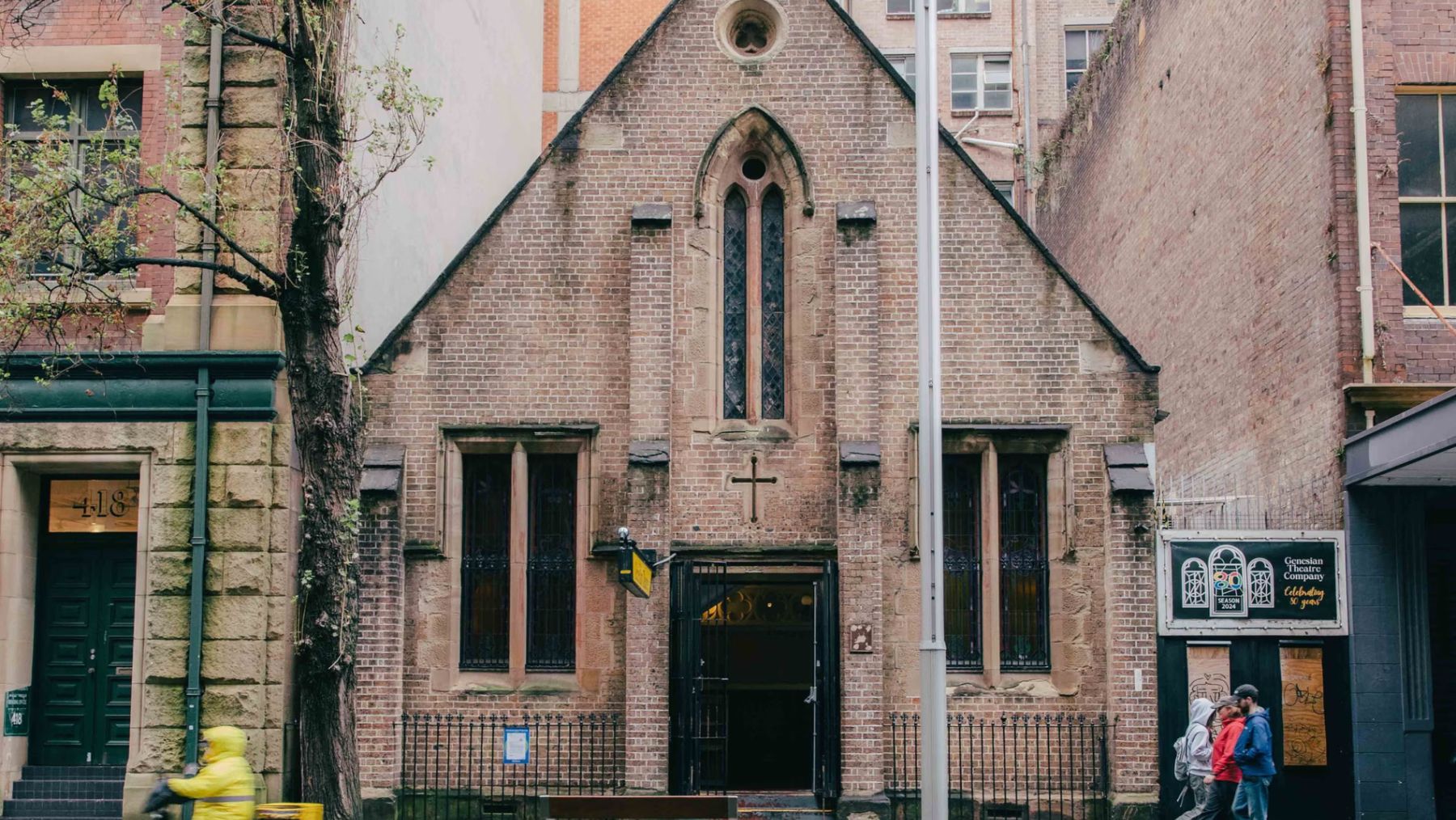
But the recent closure of the Divine Playhouse in St John the Evangelist, a former church on Kent Street that had been deconsecrated in the 1930s, has raised serious questions about just how friendly the city really is.
After months of work transforming an empty building into an LGBTQIA+-inclusive arts space, the venue held an opening party, a queer comedy night and a disco. Then religious groups protested.
The landlord accused the operators, Heaps Gay Events, of conducting “offensive trade” and terminated the lease. Volunteers were given just three days to remove the gothic signs and commissioned artworks, place months of work into storage and whitewash a colourful mural.
The landlords maintained that performances at the opening party mocked Christian beliefs and were comparable to hate speech. Drag performers dressed as nuns, religious imagery worn as jewellery and a performer dispensing French fries as a parody of communion were among the acts that offended.
Heaps Gay founder Kat Dopper sees something more serious: censorship and discrimination.
Lawyers for Heaps Gay are considering legal action. But whatever the legal outcome, Divine Playhouse has exposed an uncomfortable divide between Sydney’s international image and the experience of some of the people who live here.

Sydney’s disappearing gay venues
The eviction would be troubling in any circumstances, but it comes during an uncertain period for Sydney’s queer nightlife. Earlier this year, Oxford Street lost the Stonewall Hotel after 28 years.
It entered voluntary administration amid rising costs, changing nightlife habits and difficult trading conditions on Oxford Street. The Stonewall name survives in a new venue in Newtown, but the closure removed another landmark from the city’s traditional gay precinct.
In Redfern, community space and eclectic bar, The Bearded Tit, closed down last November. The bar owner, Joy Ng, said in a statement, “The Bearded Tit has been so much more than a bar. It has been a sanctuary for queer, POC, and other historically underrepresented communities.”
Although the closure of The Bearded Tit was a “personal” decision from Ng, as she decided to explore a career outside of hospitality, it was still seen as a big loss for Sydney’s queer nightlife.
The Mardi Gras after-party was also cancelled in 2026 because of financial pressures, while Oxford Street has endured years of construction, empty shopfronts, high rents, the legacy of the lockout laws and changing patterns of socialising.
Divine Playhouse was important because it promised something different. It was not simply another late-night bar aimed at one section of the community. It was to be a year-long home for queer comedy, visual art, performance and social events in the CBD.
Its almost immediate closure suggests that while Sydney is happy to celebrate established queer culture – particularly when hundreds of thousands of spectators and tourists are present – it may be less successful at protecting the smaller, stranger and more provocative spaces from which that culture grows.

Where are Sydney’s queer venues?
The city is certainly not devoid of LGBTQIA+ nightlife. Oxford Street remains its most visible centre, while a younger and more diverse scene has spread west through Newtown, Erskineville and Redfern.
Current venues include:
- Universal Sydney, one of Oxford Street’s principal nightclubs, with DJs, drag, dancers and late-night parties.
- Palms on Oxford, a small, unpretentious dance venue particularly popular for pop classics.
- The Oxford Hotel and Gingers, a long-established meeting place offering bars, DJs, drag and cabaret.
- The Colombian Hotel, whose prominent corner windows and upstairs bar overlook Oxford Street.
- ARQ Sydney, the large Darlinghurst nightclub known for drag and dance parties.
- The Imperial Erskineville, the celebrated home of drag, cabaret and Priscilla, Queen of the Desert history.
- Stonewall Newtown, the continuation of the Stonewall name, presenting drag, cabaret, live music and queer performance.
- Newtown Hotel, a mixed but strongly queer-friendly pub with regular drag shows.
- The Burdekin, Kinselas, The Bank, Club 77, and The Red Rattler are not exclusively gay venues but regularly host LGBTQIA+ performers, promoters, and parties.
This is a substantial scene, although it is no longer concentrated in a single, unmistakably gay strip.
So what should a visitor do?
Parties such as Heaps Gay and Poof Doof frequently occupy changing or mixed venues rather than permanent queer-owned clubs. A current Sydney gay venue guide reflects that increasingly scattered geography.
Reddit contributors commonly tell LGBTQIA+ visitors that Sydney is socially accepting and that same-sex couples are unlikely to encounter difficulty in the inner city. They recommend Darlinghurst, Surry Hills, Newtown, Erskineville and Redfern.
But many commentators frequently lament that Oxford Street is quieter and more commercial than it once was. Older contributors remember a dense collection of gay-owned pubs, clubs, bookshops, cafés and businesses. Younger users tend to describe a dispersed queer scene built around individual events, Instagram accounts and promoters.
The culture remains strong, but the clubs and pubs supporting it have weakened.

So, is Sydney gay-friendly?
For most LGBTQIA+ visitors, Sydney remains one of the world’s more welcoming cities. It has marriage equality, legal protections, openly gay political leaders, the Mardi Gras, Qtopia Sydney, rainbow crossings and neighbourhoods in which queer couples and families are an ordinary part of daily life.
One international travel study placed Sydney 27th globally and identified 188 queer-friendly hotels, more than any other Australian city (although Melbourne achieved the higher overall rating).
But a gay-friendly city cannot be measured only by the size of its annual parade or the number of corporate rainbow logos displayed in February.
It must also be judged by whether queer artists can take risks, whether independent operators can afford premises, whether patrons feel safe around police, and whether a noisy religious protest can help bring about the closure of an arts venue after three nights.
Sydney remains gay-friendly in its laws, institutions and much of its everyday life. It is less convincing when it comes to maintaining the physical spaces in which queer culture can develop without first becoming respectable, profitable or inoffensive.
Divine Playhouse was deliberately provocative, and people of faith were entitled to criticise it. But criticism is different from having a venue silenced. A truly confident, inclusive city should be capable of accommodating both the protest outside and the performance inside. Sydney’s failure to do so has not erased its rainbow credentials—but it has placed an uncomfortable stain across them.